- Home
- About Us
- Virtual Factory Tour
-
Products
- Precision Rubber Parts
- Printed Circuits
- Applications
- News
- Contact Us
Leave Your Message
Global sourcing of Neoprene Washers involves more than comparing unit prices. These small components can control sealing, vibration, electrical isolation, and surface protection. A washer that looks acceptable in a sample bag may swell, harden, or compress unevenly in service. Fit comes first.
Industry data supports a disciplined approach. Grand View Research’s Chloroprene Rubber Market report identifies automotive, electrical, and industrial applications as important demand areas for chloroprene rubber. The International Trade Centre’s Trade Map and UN Comtrade databases also show how rubber-product supply chains span multiple exporting regions. These reports help buyers understand market direction, but they do not replace product testing. Numbers can mislead.
A reliable sourcing decision should connect the application with measurable requirements. Check inner diameter, outer diameter, thickness, hardness, compression behavior, temperature exposure, and resistance to oils or chemicals. ASTM D2000 can support rubber classification, while ISO 9001 certification may indicate process control, not guaranteed washer performance. Request material declarations, inspection records, batch traceability, and representative samples before approving production. Ask whether the compound is solid neoprene or a blended elastomer. That detail matters. It can change sealing life and chemical resistance.
Cost deserves scrutiny. A lower quotation may hide weaker tolerances, inconsistent density, or poor packaging that causes deformation during ocean transport. In practical procurement reviews, specifications are often incomplete, and assumptions survive too long. That is the uncomfortable part. Buyers should challenge their own drawings, test conditions, and supplier claims before placing a global order. The best choice balances verified performance, stable manufacturing, documented quality, and realistic logistics.
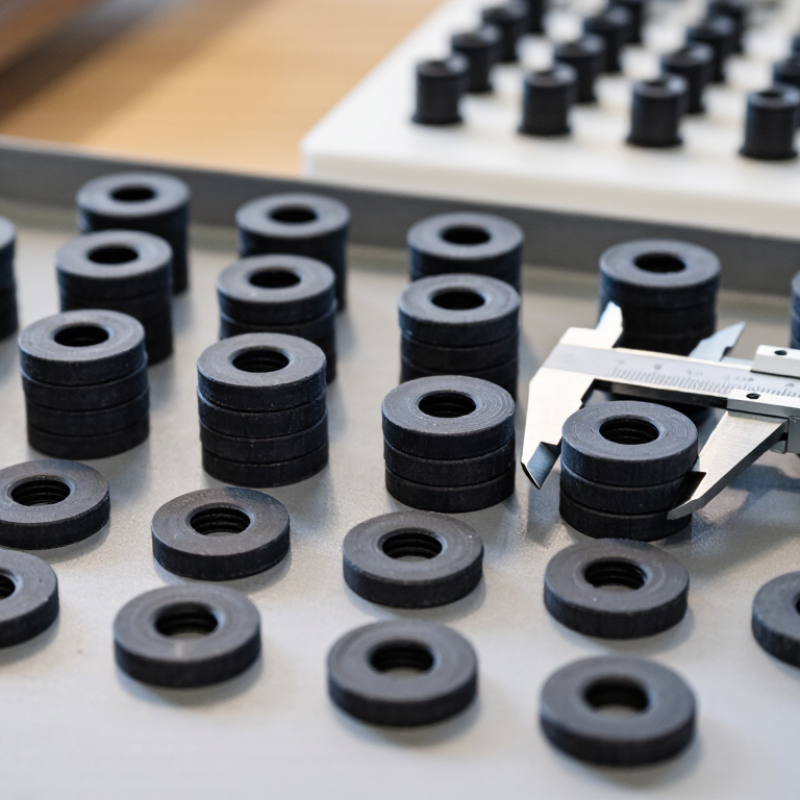
Choosing neoprene washers begins with the application, not the catalogue. In field sourcing, I check temperature, moisture, compression, and the mating material before requesting prices. Neoprene, also called chloroprene rubber, offers useful resistance to weathering, ozone, oils, and moderate chemicals. It remains flexible across a practical temperature range, but exact limits depend on compound and formulation. Small detail. Hardness affects sealing pressure and recovery. A softer washer can conform to uneven surfaces, while a harder grade resists extrusion under load.
For outdoor electrical enclosures, roofing fasteners, plumbing joints, and vibration-prone assemblies, neoprene washers can reduce water entry and surface damage. Their resilience helps absorb minor movement between a screw head and the panel. Diameter, thickness, inner-hole size, and tolerance must match the fastener. A loose inner hole may leak. A tight one may tear during installation. Compression set deserves attention. If the washer stays flattened after heat and pressure, sealing performance can decline. Ask for test data. Useful records include hardness, tensile strength, elongation, density, aging results, and dimensional inspection.
Global sourcing adds practical risks. Drawings should state units, tolerances, material grade, color limits, and packaging conditions. Samples should face humidity, heat, and repeated compression when the application is critical. I have seen attractive samples fail after storage because packaging allowed deformation. That mistake is easy to miss. Verify lot traceability and change-control procedures before approving production. Neoprene is not suitable for every fluid or temperature. When exposure is uncertain, a compatibility test is safer than confident guessing. Good specifications make comparison possible, even when suppliers interpret “neoprene washer” differently.
| Selection Dimension | Typical Data or Range | Why It Matters | Recommended Application | Global Sourcing Checkpoint |
|---|---|---|---|---|
| Base Material | Polychloroprene rubber, commonly known as neoprene | Provides a balanced combination of flexibility, weather resistance, moderate oil resistance, and sealing performance. | Outdoor fasteners, electrical enclosures, HVAC equipment, machinery, and general-purpose sealing. | Request the material specification and confirm whether the compound is virgin, recycled, or blended. |
| Standard Hardness | Approximately 60–80 Shore A | Lower hardness improves conformity to uneven surfaces; higher hardness improves support and resistance to deformation. | 60–70 Shore A for general sealing 70–80 Shore A for higher clamping loads |
Require hardness tolerance, test method, and sampling conditions in the purchase specification. |
| Service Temperature | Typically about −35°C to +100°C; short-term exposure may be higher depending on the compound | Temperature affects elasticity, compression set, and long-term sealing reliability. | Outdoor equipment, engine-adjacent components with moderate heat, and general industrial assemblies. | Specify continuous and intermittent temperatures separately; validate the actual compound for extreme conditions. |
| Compression Set | Common commercial target: approximately 20–40% after a defined test cycle | Lower compression set generally indicates better recovery after prolonged compression and improved seal retention. | Static seals, panels, covers, flanges, and vibration-isolation assemblies. | Compare results only when temperature, duration, specimen size, and test standard are identical. |
| Weather and Ozone Resistance | Good resistance to sunlight, ozone, moisture, and outdoor aging compared with many general-purpose rubbers | Helps reduce cracking and loss of flexibility in exposed installations. | Solar mounting hardware, exterior panels, communication cabinets, and outdoor machinery. | For long-term outdoor use, request accelerated aging or ozone-resistance test data. |
| Fluid Compatibility | Generally suitable for water, dilute acids, alkaline solutions, and selected mineral oils; compatibility varies by formulation | Some fuels, aromatic solvents, strong oxidizers, and concentrated chemicals can cause swelling or deterioration. | Water systems, light industrial equipment, and protected mechanical assemblies. | Provide the exact fluid, concentration, temperature, and exposure time before approving the material. |
| Electrical Insulation | Neoprene is normally electrically insulating, subject to compound formulation and moisture conditions | Supports separation between metal components and helps protect against abrasion and vibration. | Electrical cabinets, cable glands, connectors, and low-voltage equipment enclosures. | Request dielectric or insulation data when the washer is part of a safety-critical electrical assembly. |
| Inside Diameter | Should provide adequate clearance over the fastener; commonly specified slightly above the bolt or screw diameter | Prevents installation interference while maintaining even load distribution around the hole. | Bolted joints, sheet-metal panels, roofing components, and enclosure covers. | Define nominal size, tolerance, and whether dimensions are measured before or after finishing. |
| Outside Diameter | Usually selected to provide sufficient bearing area without interfering with nearby components | A larger outside diameter spreads clamp load and reduces the risk of surface damage or pull-through. | Thin sheet metal, painted surfaces, plastic housings, and soft substrates. | Check the available seating area and specify the minimum required bearing diameter. |
| Thickness | Common commercial thicknesses include approximately 1.0–3.0 mm; thicker custom parts are also possible | Thickness influences sealing compression, electrical spacing, flexibility, and stack-up dimensions. | Thin washers for panel sealing; thicker washers for vibration absorption and larger surface irregularities. | Define thickness tolerance and the required compressed thickness, not only the free thickness. |
| Dimensional Tolerance | Typical molded or die-cut tolerances may range from ±0.10 mm to ±0.30 mm, depending on size and process | Tight tolerances improve assembly consistency but may increase tooling and inspection costs. | High-volume assemblies, automated installation, and parts with limited clearance. | Agree on inspection gauges, sampling plans, critical dimensions, and acceptable flash. |
| Manufacturing Process | Die cutting for flat sheet washers; molding for complex profiles, higher precision, or integrated features | Process selection affects edge quality, dimensional repeatability, tooling cost, and production volume economics. | Die-cut parts for standard flat washers; molded parts for specialized sealing geometries. | Confirm tooling ownership, production capacity, first-article approval, and process capability. |
| Surface Finish | Usually smooth or lightly textured; optional adhesive backing or fabric reinforcement may be specified | Surface condition affects sealing, friction, handling, and resistance to movement during assembly. | Cabinet covers, access panels, vibration-control points, and installation-sensitive assemblies. | Specify surface cleanliness, flash limits, release-agent restrictions, and packaging protection. |
| Color and Identification | Black is common; other colors may be available for identification or visual inspection | Color can support part differentiation but does not by itself confirm material performance. | Multi-part assemblies, maintenance kits, and color-coded installation systems. | Use material and test requirements rather than color as the acceptance criterion. |
| Packaging for International Shipping | Clean, dry, sealed bags or cartons with quantity labels and batch identification | Protects washers from dust, moisture, deformation, and mix-ups during long-distance transport. | All export orders, especially small components supplied in high quantities. | Specify inner-pack quantity, carton limits, batch traceability, labeling language, and storage conditions. |
| Storage Conditions | Cool, dry, dark storage away from ozone-generating equipment, direct sunlight, oils, and solvents | Proper storage helps preserve elasticity and reduces premature aging before installation. | Warehouses, distribution centers, maintenance inventories, and seasonal projects. | Set a recommended shelf-life policy and require production dates or lot numbers on packaging. |
| Quality Documentation | Material certificate, dimensional inspection report, hardness report, and batch traceability records | Documentation supports supplier comparison, incoming inspection, and corrective-action management. | Regulated industries, repeat orders, and applications with critical sealing requirements. | Align documents with the purchase order and define which tests require third-party verification. |
| Best-Fit Use Case | Static sealing and load distribution where moderate heat, outdoor exposure, and flexibility are required | Neoprene offers a practical balance of performance and cost for many general industrial applications. | Enclosures, panels, outdoor hardware, HVAC equipment, machinery, and electrical assemblies. | Consider silicone, EPDM, fluorocarbon, or nitrile alternatives when temperature or chemical exposure exceeds neoprene limits. |