Leave Your Message

10 Essential Tips for Understanding Force-Sensitive Resistors?

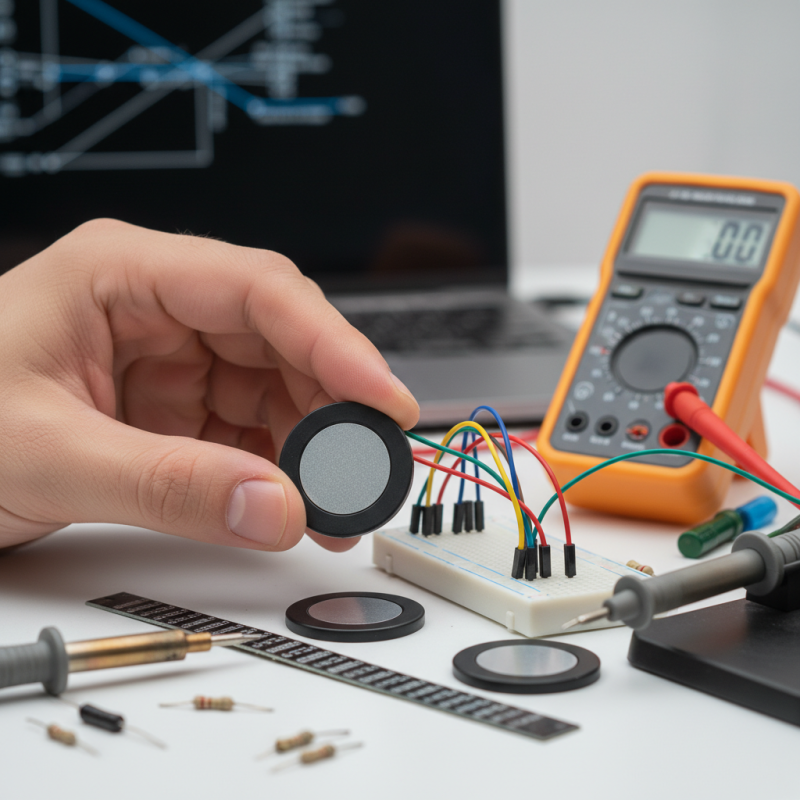
Understanding Force-Sensitive Resistors (FSRs) can significantly enhance your projects. These devices are unique sensors that detect pressure and force applied to their surface. They're widely used in various industries, from consumer electronics to healthcare applications.

Force-Sensitive Resistors work on a simple principle. When pressure is applied, their resistance changes, allowing for precise measurements. This technology can be applied in innovative ways, making it essential for engineers and hobbyists alike.

As you explore these devices, it’s important to consider their limitations. FSRs may not provide the same accuracy as other sensors. They can be affected by environmental conditions. Understanding these nuances will help you utilize Force-Sensitive Resistors effectively. This article provides essential tips to navigate their complexities and maximize their potential.
10 Essential Tips for Understanding Force-Sensitive Resistors?

What are Force-Sensitive Resistors and How Do They Work?

10 Essential Tips for Understanding Force-Sensitive Resistors?

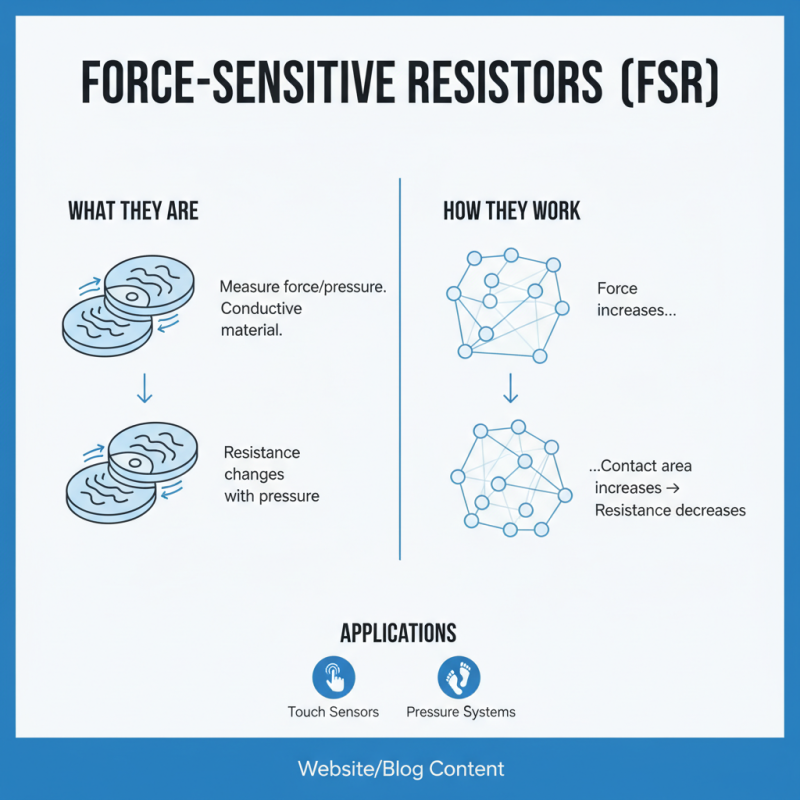
Force-sensitive resistors (FSRs) are unique devices used to measure force or pressure. They consist of a conductive material that changes its resistance when pressure is applied. The principle behind their operation is straightforward: as force increases, the contact area between particles in the sensor's material changes, leading to a decrease in resistance. This allows them to function effectively in various applications, from simple touch sensors to more complex pressure-sensitive systems.

FSRs are often favored for their simplicity and low cost. They are lightweight and can be configured in various shapes and sizes. However, they aren't perfect. One limitation is their non-linear response to pressure. This means that small forces might result in significant resistance changes, while larger forces lead to smaller changes. This can complicate precise measurements. Users must consider this when integrating FSRs into their projects.

In many applications, the sensitivity and range of FSRs can be both a strength and a weakness. For instance, in robotics, they can enable responsive actions but may also risk inaccuracies in high-pressure scenarios. Experimentation and calibration are essential for optimizing their performance. Understanding these nuances is key to leveraging FSR technology effectively.

Key Applications of Force-Sensitive Resistors in Various Industries

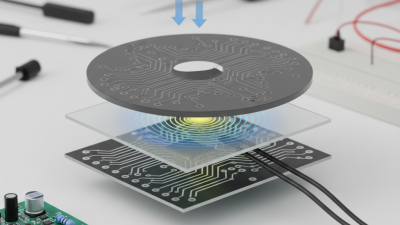
Force-sensitive resistors (FSRs) play a crucial role in various industries. They are widely used in electronics, healthcare, automotive, and consumer goods. In electronics, FSRs are commonly found in touch-sensitive interfaces and gaming controllers. These devices benefit from their sensitivity, allowing for precise input based on pressure applied.

In healthcare, FSRs contribute to patient monitoring systems. For example, beds equipped with FSRs can detect a patient's movements. This technology helps in preventing bedsores by alerting caregivers when patients shift too little. It's a powerful application that enhances patient care, though its accuracy can vary based on usage and calibration.

Automotive manufacturers also embrace FSR technology. They use these sensors in safety systems and driver assistance features. FSRs can gauge the pressure on seat belts or detect occupancy in seats. This is critical for deploying airbags properly. However, the implementation can lead to inconsistencies. Variability in sensor placement can influence performance. Understanding these nuances is essential for optimization across applications.

Understanding the Electrical Characteristics of Force-Sensitive Resistors

Force-sensitive resistors (FSRs) are vital components in various applications. They detect pressure, force, or touch. Understanding their electrical characteristics helps in harnessing their full potential. An FSR changes resistance based on the force applied. Typically, they exhibit nonlinear behavior. This is essential for accurate readings in sensors or control systems.

When working with FSRs, knowing how they respond to different levels of pressure is crucial. They often have a high resistance when no force is applied and a significant drop in resistance under pressure. Experiment with applying various forces to observe the resistance changes. This hands-on approach enhances your understanding of their behavior.

One tip is to consider the load resistance in your circuit design. If the load resistance is too high, it could lead to inaccurate readings. Additionally, use a multimeter to measure resistance changes while applying force. This practical technique provides clarity on how much pressure generates a specific resistance change. Reflect on how these characteristics could impact the overall design of your project.

Installation Guidelines for Force-Sensitive Resistors in Projects

When incorporating force-sensitive resistors (FSRs) into projects, proper installation is crucial for optimal performance. The positioning of FSRs significantly influences their sensitivity and accuracy. For instance, locate sensors where force is consistently applied. If the surface is uneven, the readings may fluctuate. Reports indicate that improper installation can lead to up to 30% variance in sensor outputs.

Depending on the project, you might need to calibrate the sensor. Calibration involves applying known forces and adjusting the output readings accordingly. This is vital for achieving more precise measurements. Ensure to use adequate pressure to prevent sensor damage. Forces that exceed the rated limit can lead to permanent changes in resistance or complete failure.

A clean surface is essential before installation. Dust and debris can disrupt readings by creating additional friction. When soldering connections, avoid excess heat, which can easily damage the component. Many new users overlook this step, leading to inconsistent results. Regular testing should be performed to validate functionality after installation. Understanding these nuances can enhance the effectiveness of FSRs in various applications, reinforcing the need for careful planning.

10 Essential Tips for Understanding Force-Sensitive Resistors - Installation Guidelines for Force-Sensitive Resistors in Projects

Tip Number Tip Description Installation Considerations Common Applications
1 Understand the principle of operation. Ensure proper calibration to maintain accuracy. Touch-sensitive controls.
2 Select appropriate sensors for your project. Consider size and force sensitivity ratings. Pressure mapping.
3 Ensure proper electrical connections. Use low-resistance wiring for better signal. Robotic applications.
4 Handle with care to avoid damage. Use appropriate tools for mounting. Wearable technology.
5 Test the sensors before use. Check for correct voltage and resistance. Gaming devices.
6 Understand the environment of installation. Protect from moisture and high temperatures. Automated systems.
7 Optimize design for compact integration. Design for ease of access and maintenance. Medical devices.
8 Use proper programming to interpret data. Ensure calibration in the software system. Interactive exhibits.
9 Consider the mounting technique. Use adhesive or screws as appropriate. Industrial automation.
10 Regularly check and maintain the sensors. Schedule periodic inspections for wear and tear. Feedback systems.

Common Issues and Troubleshooting Tips for Force-Sensitive Resistors

Force-sensitive resistors (FSRs) are widely used in various applications, from robotics to wearable technology. Understanding common issues that arise with FSRs is crucial for effective troubleshooting. A significant challenge is non-linearity due to inconsistent pressure sensitivity across the sensor's surface. This can result in erroneous readings that affect performance. According to industry reports, approximately 25% of FSR failures stem from these sensitivity inconsistencies.

Another common problem is durability, particularly in high-use environments. Many FSRs are not designed to withstand repetitive stress, which can lead to a decline in accuracy. An estimated 30% of FSRs experience performance drops after extensive usage. Users should regularly check the condition of the sensors and replace them when degradation is noticed. Additionally, environmental factors such as humidity and temperature can impact reliability. Maintaining optimal conditions is vital for consistent data output.

When troubleshooting FSRs, proper calibration is essential. Inaccurate calibration can exacerbate issues and result in misleading sensor data. Approximately 20% of user errors are linked to calibration mistakes. Regular testing and adjustments can mitigate these problems, enhancing performance and ensuring that FSRs continue to function effectively in their intended applications. Identifying these areas for improvement fosters a better understanding of how to manage FSRs successfully.

Force-Sensitive Resistors Performance Analysis

This bar chart illustrates the relationship between applied force and the resistance of force-sensitive resistors (FSRs). As the force increases, the resistance decreases, demonstrating the typical behavior of FSRs used in various applications.