What is Ito Thin Film and its Applications in Technology?
Ito Thin Film has emerged as a pivotal component in various technological applications. This material, composed predominantly of indium tin oxide (ITO), is known for its remarkable electrical conductivity and optical transparency. These unique properties make Ito Thin Film highly sought after in fields ranging from electronics to renewable energy.
The application of Ito Thin Film in touchscreen technology exemplifies its significance. Smartphones and tablets rely on ITO-coated glass screens for touch sensitivity. These screens must balance clarity with responsiveness, making ITO an ideal material choice. Additionally, solar cells use Ito Thin Film to improve efficiency and transmission of light. This highlights the versatility of ITO beyond consumer electronics.
Despite its advantages, Ito Thin Film production faces challenges. The cost of raw materials can fluctuate widely. This impacts the overall price and availability of devices utilizing ITO. Furthermore, developing alternatives without sacrificing performance remains a substantial hurdle. Researchers are exploring new materials, but ITO's established benefits make replacement complex. The future of ITO Thin Film may hold both promise and uncertainty.

Overview of Ito Thin Film Technology
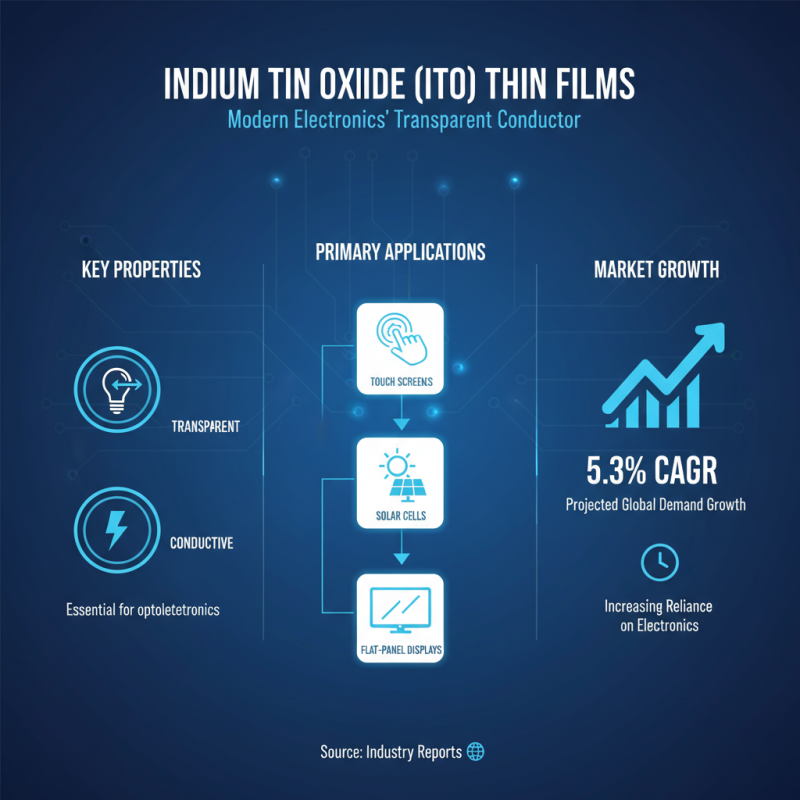
Indium tin oxide (ITO) thin films are pivotal in modern electronics. They are transparent conductors, essential in touch screens, solar cells, and flat-panel displays. The global demand for these materials is projected to grow at a CAGR of 5.3%, as highlighted in recent industry reports. This growth reflects an increasing reliance on electronic devices.
ITO thin films are made by combining indium oxide and tin oxide. This unique composition provides excellent electrical conductivity and optical transparency. Typically, their thickness ranges from 100 nm to 200 nm. Despite these advantages, there are challenges in manufacturing quality. The inconsistency in film thickness can lead to performance variability.
ITO is also a crucial component in energy-efficient technologies. With renewable energy's rise, its use in solar panels enhances energy conversion efficiency. Yet, reliance on indium raises sustainability concerns due to limited resources. There is an ongoing need for research and development into alternative materials that can match or exceed ITO's properties. The balance between performance and resource sustainability remains a key topic in the industry.
Key Properties of Indium Tin Oxide Films
Indium Tin Oxide (ITO) films are vital in modern technology due to their unique properties. These films exhibit high electrical conductivity and excellent optical transparency. For instance, studies have shown that ITO films can achieve up to 90% transmittance in the visible spectrum while maintaining low resistivity values of around 10-4 ohm cm. This dual functionality makes them ideal for applications in touch screens and solar cells.
What sets ITO apart is its versatility. Not all ITO films are created equal. Variations in deposition techniques and doping levels can lead to different characteristics. Some applications require films that are more conductive but less transparent. In contrast, others need the opposite. A report indicated that precise control over film thickness can influence these properties significantly, sometimes introducing trade-offs.
While ITO films drive technological advancements, challenges persist. The materials are not eco-friendly, raising concerns about sustainability. Alternatives, such as silver nanowires and graphene, show promise but lack certain performance metrics of ITO. Thus, continued research is imperative. The industry must balance performance with environmental impact. As technology evolves, so must our materials and practices.
Applications of Ito Thin Films in Electronics
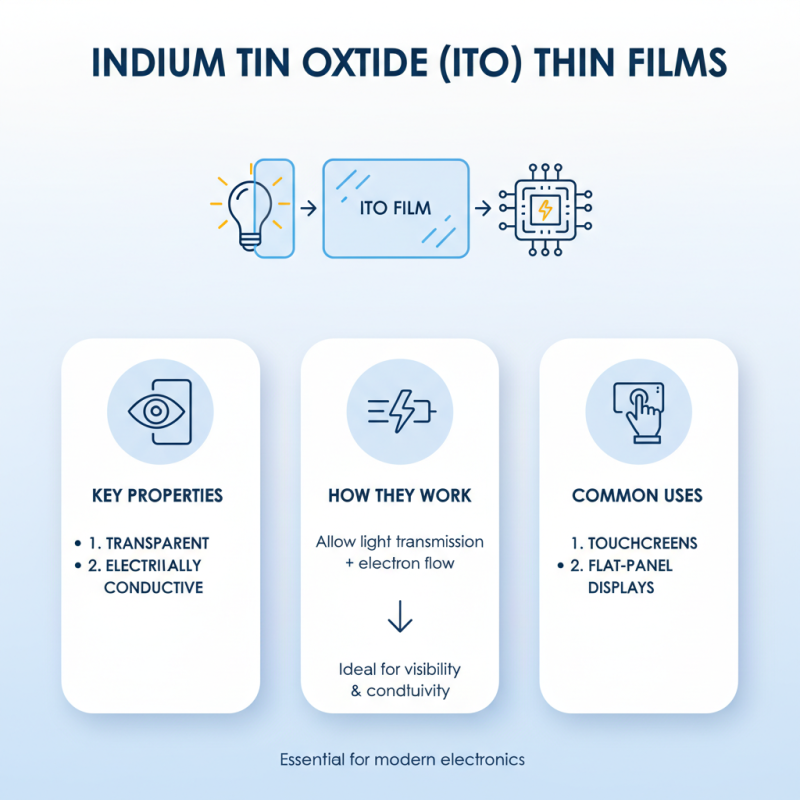
Indium tin oxide (ITO) thin films are widely used in electronics due to their unique properties. These films are transparent conductors, making them ideal for applications where visibility is crucial. They allow light to pass through while conducting electricity. This combination is essential for devices like touchscreens and displays.
In smartphones and tablets, ITO thin films serve as touch sensors. They help detect user interactions on the glass surface. This technology enables smooth and responsive touchscreen experiences. Additionally, ITO is found in solar cells. Here, they contribute to efficient light absorption. However, there are challenges. ITO can be brittle and may not withstand harsh conditions. Researchers are exploring alternatives to enhance durability.
Another area of application is in organic light-emitting diodes (OLEDs). ITO thin films are used as anode layers. They provide excellent electrical conductivity. Nevertheless, the production of ITO can be costly and resource-intensive. Finding sustainable methods is an ongoing concern. Innovations are needed to overcome these limitations and improve the functionality of ITO in electronics.
Role of Ito Thin Films in Optoelectronic Devices
Indium tin oxide (ITO) thin films are pivotal in optoelectronic devices. Their unique properties make them ideal for applications such as transparent conductive films, solar cells, and touch screens. ITO films offer high transparency, typically over 85%, and low electrical resistivity, around 10^-4 ohm-cm. This combination is crucial for maximizing device efficiency while maintaining visual aesthetics.
In solar energy applications, ITO thin films serve as transparent electrodes, crucial for light absorption and electron transport. Reports indicate that devices utilizing ITO can achieve efficiency rates exceeding 20%. Yet, the reliance on indium raises concerns about supply stability and environmental impact. While ITO performs well, alternative materials are being explored. These alternatives could reduce dependency on scarce resources.
Touch screens and display technologies also benefit from ITO’s properties. However, the fragility of ITO thin films poses challenges. Manufacturing defects can lead to significant reduction in performance. Research is ongoing to enhance durability while maintaining optical and electrical properties. As industries evolve, the demand for robust, cost-effective alternatives grows. The journey toward perfecting these materials is ongoing, and careful consideration is needed to balance performance with sustainability.
Application of ITO Thin Films in Optoelectronic Devices
This chart represents the various applications of ITO thin films in different optoelectronic devices, showcasing their significance in technology.
Future Trends and Innovations in Ito Thin Film Development
The future of Ito thin film technology holds immense promise. This innovative material, primarily composed of indium tin oxide, is gaining traction in various fields. Researchers are exploring ways to enhance its conductivity and transparency. Advances in material science may pave the way for better performance and reduced costs.
Emerging applications include flexible electronics and energy-efficient displays. These advancements will challenge current manufacturing techniques. New methods like roll-to-roll processing could revolutionize production efficiency. However, the scalability of these innovations remains a critical issue. Sustainability in sourcing indium is another point for reflection.
The potential for Ito thin films in renewable energy is also noteworthy. They may enhance solar cell efficiency and further reduce costs. Exploring these avenues entails constant testing and iteration. Collaboration across industries will be crucial for pushing boundaries. While progress is evident, the path forward requires careful navigation of challenges.