- Home
- About Us
- Virtual Factory Tour
-
Products
- Precision Rubber Parts
- Printed Circuits
- Applications
- News
- Contact Us
Leave Your Message
Choosing the best Force-Sensitive Resistor supplier in 2026 requires more than comparing catalog prices. Buyers must examine material consistency, sensing range, response time, hysteresis, drift, and long-term repeatability. A low-cost sheet may appear attractive, yet unstable readings can increase calibration work and field failures.
Professor Ravinder Dahiya, a recognized tactile-sensing researcher, has stated, “Tactile sensing enables safer, more intelligent human–machine interaction.” This principle matters when selecting suppliers for robotic grippers, medical interfaces, automotive controls, and wearable devices. A reliable supplier should provide clear force-versus-resistance curves, dimensional drawings, test conditions, and practical integration guidance. Samples should be tested under real pressure patterns, not only ideal laboratory loads.
Supplier evaluation also includes manufacturing discipline. Check traceability, quality certifications, customization capabilities, minimum order quantities, and technical support. Ask how the supplier manages temperature effects, repeated loading, connector durability, and adhesive compatibility. These details can decide whether a sensor performs consistently beneath a flexible membrane or inside a compact control panel.
No supplier is perfect. Every Force-Sensitive Resistor has limitations, including tolerance variation and measurement drift. That reality deserves honest discussion. The strongest candidates explain weaknesses clearly and recommend suitable calibration methods. This 2026 guide compares established manufacturers, specialized producers, and emerging suppliers through practical performance, engineering support, delivery reliability, and total ownership value. The final choice should reflect the application’s real demands, not marketing claims alone.

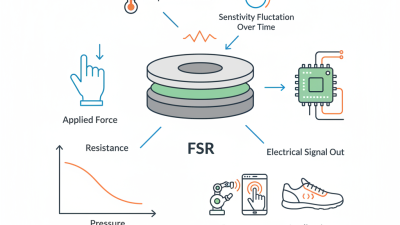
A force sensitive resistor (FSR) is a thin, pressure-responsive component. Its resistance changes when mechanical force reaches its active surface. Most FSRs use layered polymer films and conductive particles. Pressing the surface creates more conductive contact points. Resistance then decreases as force increases. Think of it as a soft electrical dimmer. Not a precise load cell. That distinction matters.
A voltage-divider circuit converts resistance changes into measurable voltage. A microcontroller then reads this voltage through an analog-to-digital converter. Light pressure may produce a small signal, while stronger pressure creates a larger response. However, the relationship is rarely perfectly linear. Hysteresis, temperature, bending, and surface texture can affect readings. Calibration is essential. A 2024 MarketsandMarkets force-sensor report projects high-single-digit market growth through 2028, driven by robotics, healthcare equipment, and automotive controls. Grand View Research also identifies automation and wearable devices as important application areas.
When comparing FSR suppliers, engineers should request force-resistance curves, thickness tolerances, connector details, and lifecycle-test results. Test samples under real conditions. A fingertip, a machine pad, and a shoe sole apply force differently. Supplier data may look clean. Production behavior can be less predictable. That is the catch. Designers should also check repeatability, response time, adhesive stability, and minimum order requirements. FSR technology is affordable and flexible, but it should not replace accurate weighing systems without careful validation.
| Evaluation Dimension | Typical FSR Information | Why It Matters | Supplier Evidence to Request |
|---|---|---|---|
| Operating principle | Resistance generally decreases as applied force increases because conductive particles move closer together inside a pressure-sensitive material. | Confirms whether the device is suitable for detecting touch, pressure, grip, or force changes. | Resistance-versus-force curve, test conditions, and electrical measurement method. |
| Sensing technology | Most FSRs use a flexible polymer substrate with a printed conductive or resistive layer and a spacer or separating structure. | Construction affects flexibility, durability, response repeatability, and environmental performance. | Material stack-up, cross-section drawing, substrate material, and manufacturing process description. |
| Minimum detectable force | Common products are designed for forces ranging from light touch levels to several kilograms, depending on geometry and construction. | A sensor designed for touch detection may not reliably measure heavier loads, while a high-force design may be less sensitive to light contact. | Minimum detectable force, rated force range, force application fixture, and tolerance limits. |
| Resistance range | Resistance varies by design and force; unloaded resistance may be very high, while pressed resistance can fall substantially. | The resistance range determines the required pull-up resistor, ADC range, current consumption, and signal-conditioning circuit. | Unloaded resistance, resistance at specified forces, tolerance, and recommended circuit values. |
| Electrical interface | An FSR is a passive two-terminal variable resistor and is commonly read with a voltage-divider or constant-current circuit. | Simple integration is useful for microcontrollers, wearable electronics, human-machine interfaces, and robotics. | Reference schematic, recommended excitation voltage, current limits, connector details, and calibration guidance. |
| Accuracy and linearity | FSRs are generally better suited to relative force or touch detection than to high-precision force measurement. Their force-resistance relationship is typically nonlinear. | Applications requiring certified or highly accurate force values may need calibration, compensation, or a different sensor technology. | Linearity error, repeatability, hysteresis, creep, calibration procedure, and measurement uncertainty. |
| Response time | Thin-film FSRs commonly provide fast electrical response, but the complete system response also depends on mechanical mounting, signal filtering, and sampling rate. | Fast response is important for interactive controls, robotic feedback, musical interfaces, and dynamic touch input. | Rise time, release time, test load profile, sampling conditions, and filtering recommendations. |
| Hysteresis and repeatability | The resistance at a given force can differ between loading and unloading cycles; repeatability is affected by force history and mechanical alignment. | Low hysteresis and stable repeatability improve threshold detection and reduce recalibration frequency. | Loading/unloading curves, cycle-test results, standard deviation, and defined acceptance criteria. |
| Creep and long-term drift | Under a constant load, the output may change over time because of viscoelastic behavior in the sensing layers and mechanical structure. | Important for applications involving sustained pressure, occupancy detection, or long-duration gripping. | Creep test duration, drift percentage, recovery behavior, and recommended duty cycle. |
| Mechanical format | Available formats commonly include circular, square, strip, matrix, and custom flexible shapes. Active areas and tail designs vary by application. | The active area, thickness, bend radius, and tail orientation determine how easily the sensor fits into the product. | 2D drawing, dimensional tolerances, active-area definition, minimum bend radius, and custom tooling requirements. |
| Environmental capability | Temperature, humidity, contamination, flexing, and enclosure design can affect FSR output and service life. | Environmental matching is essential for automotive, medical, industrial, outdoor, and wearable products. | Operating and storage temperature, humidity testing, ingress protection of the assembly, and chemical compatibility data. |
| Durability | Life depends on force level, actuation speed, travel, bending, mounting method, and the number of load cycles. | A sensor suitable for occasional user input may not be suitable for continuous industrial actuation. | Actuation-life test results, maximum recommended cycles, failure definition, and mounting conditions. |
| Customization capability | Customization may include shape, size, tail, connector, adhesive, active-area pattern, resistance profile, and multi-zone layouts. | A custom design can improve mechanical integration and reduce the need for additional brackets or signal conditioning. | Prototype process, tooling charges, engineering-change procedure, minimum order quantity, and production lead time. |
| Quality and compliance | Quality programs, traceability, documented inspection, and application-specific compliance should be verified rather than assumed. | Documented controls reduce variation between production lots and support regulated-product development. | Quality certifications, material declarations, inspection plans, lot traceability, certificates of conformity, and audit results. |
| Best-fit application | Touch interfaces, grip detection, seat or bed occupancy, robotic fingers, wearable controls, musical interfaces, and pressure mapping. | Application fit should be judged by the required force range, accuracy, life, environmental exposure, and available calibration method. | Application references, sample test results, engineering support, and a validation plan using the final mechanical assembly. |
Note: FSR specifications vary by construction, active area, mounting method, and test conditions. Supplier comparisons should use data measured under the same force profile, fixture, temperature, humidity, and calibration procedure.